
Warrensburg Historic Directory Holdings
Warrensburg's documented directory shelf begins with specific volumes, not an unbroken run. Official preservation bibliographies identify books from 1888-89, 1895 or 1895-96, 1900-01, 1955, 1957, 1958, 1963, 1967, and 1972. The citations point to the Johnson County Historical Society and local library context, but their public pages do not publish a complete shelf list or prove that every year between those dates exists. Ask for the volume itself, its page, and its repository before treating a gap as a missing resident.
| Collection | Years | Where Held | Access |
|---|---|---|---|
| Western Directory Co. City Directory of Warrensburg | 1888-1889 | Official preservation bibliography; confirm local copy with JCHS or library | Repository inquiry |
| Irving & Kunkel and Wallin, Shaffer & Co. directories | 1895 or 1895-96; 1900-1901 | State preservation bibliographies and JCHS reference | Repository inquiry |
| Paul Minors and later Warrensburg directories | 1955, 1957, 1963, 1967, 1972 | JCHS and official bibliography citations | Ask staff for volume and page access |
| Service Company Cross-Directory | 1958 | JCHS; official National Register bibliography | Address-first historical research |
| Urban and Local Collection | Years vary | Johnson County Library Genealogy Desk | Staff-assisted local-history collection |
The state preservation bibliography and the National Register bibliography document the named runs. They do not establish a first printed directory, a final printed directory, or annual publication. That uncertainty is part of an accurate Warrensburg historical-directory search.
Warrensburg Directory Years and Gaps
The early sequence gives useful checkpoints. The Western Directory Co. volume covers 1888-89, Irving & Kunkel is cited for 1895 or 1895-96, and Wallin, Shaffer & Co. bridges 1900-01. After a long undocumented gap in the inspected sources, the known mid-century sequence includes Paul Minors in 1955, a 1957 title with publisher not stated in the bibliography, the Service Company in 1958 and 1963, and Baldwin Consurvey titles in 1967 and 1972. A directory hit establishes a printed listing for that volume, not an uninterrupted residence.
| Period | Warrensburg directory checkpoint | Best paired source |
|---|---|---|
| 1888-1901 | 1888-89, 1895 or 1895-96, and 1900-01 documented titles | 1900 federal census, deeds, tax material, and newspapers |
| 1955-1963 | 1955, 1957, 1958 Cross-Directory, and 1963 titles | 1950 census, obituary cards, and local newspapers |
| 1967-1972 | Baldwin Consurvey titles identified for 1967 and 1972 | Deeds, plats, obituaries, and yearbooks |
| Absent year | No annual local volume established by the inspected sources | Ask the library, JCHS, or Archives for another record class |
The 1890 federal population schedules were destroyed by fire, so a blank search needs a substitute trail. The surviving 1890 veteran and widow special census, tax records, newspaper binders, deeds, cemetery records, and nearby directory volumes can fill part of that space. They are not interchangeable, but each supplies a different dated fact.
Warrensburg Genealogy Desk Sources
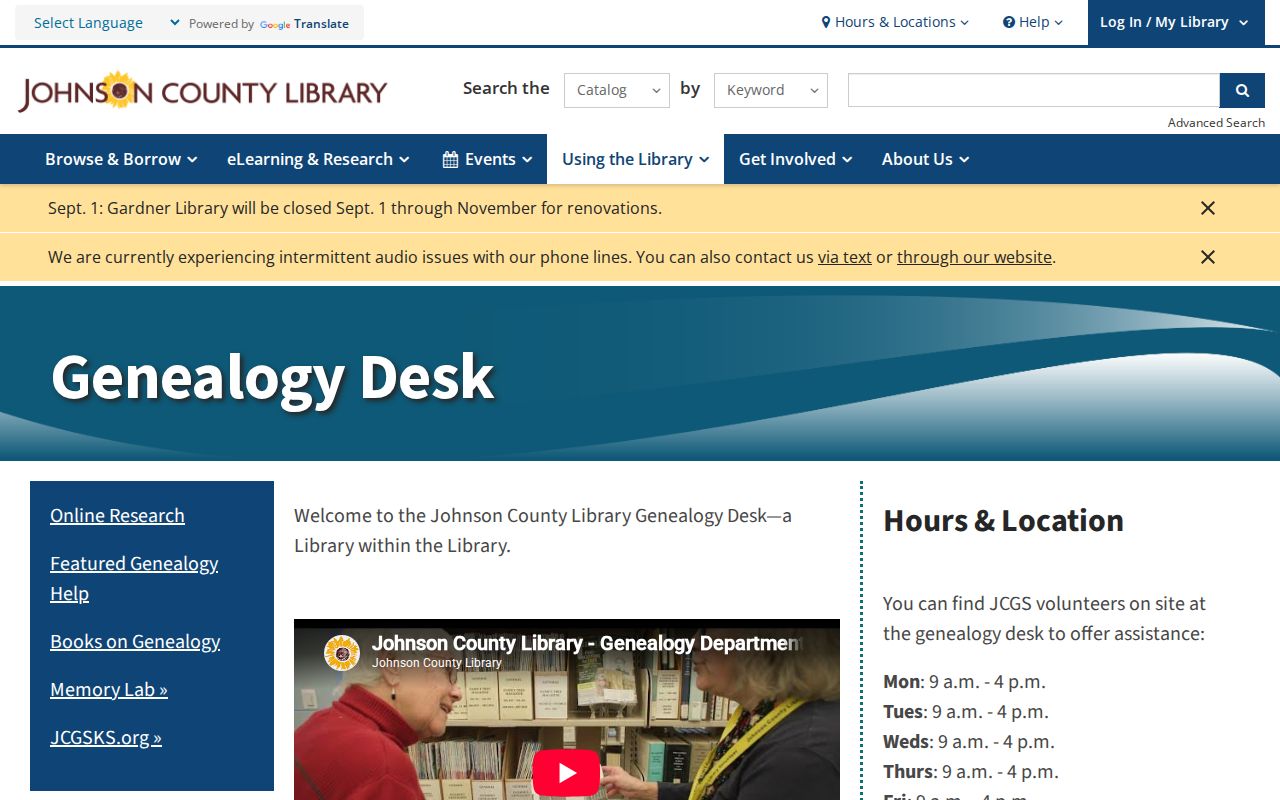
The Johnson County Library Genealogy Desk is the most direct local access channel for Warrensburg directories. Johnson County Genealogical Society volunteers staff it Monday through Saturday from 9 a.m. to 4 p.m. and Sunday from 2 p.m. to 4 p.m. The collection includes research computers, online genealogy tools, books, microfilm, microfiche, city directories, local yearbooks, community histories, maps reaching back to 1860, handouts, and an obituary card collection for 1977-2000. These resources let a researcher check a directory listing against a map, news item, yearbook, or obituary card in the same visit.
The screenshot is from the Johnson County Library Genealogy Desk. It represents the local shelf and staff route for a Warrensburg historical-volume question when no confirmed online scan is available.
For nearby newspaper work, Trails Regional Library's Warrensburg Branch at 432 N. Holden has public computers, a microfilm reader/printer, printing, and scanning. Its listed hours are Monday through Wednesday 8 a.m. to 7 p.m., Thursday and Friday 8 a.m. to 5 p.m., and Saturday 9 a.m. to 5 p.m. Library staff can help identify a run or a microfilm format, while the researcher should capture the exact citation.
Note: The Genealogy Desk can locate a local source, but an entry should still be recorded with its volume, year, page, and repository.
Warrensburg's 1958 Cross-Directory
The 1958 Cross-Directory is the unusual Warrensburg historical directory volume. Published by The Service Company, it offers an address-first route among otherwise alphabetical local books. When the address is known but the person is not, start there, then check the alphabetical section for the same address, name variant, business or occupation clue. This makes the cross-directory useful for historic house research, but it does not make the printed name a title record or a complete household list.
Try the street suffix, a nearby cross street, and any known subdivision or lot/block clue if the address is absent. Street descriptions changed between historic maps, deeds, and present-day postal styles. The 1958 title is a single documented source. It should not be stretched into a claim that Warrensburg published a reverse book every year or that the volume contains every resident.
For a current parcel or recorded-instrument trail after the historical address is identified, use the Warrensburg street records by address. That route keeps the historic printed listing separate from modern property evidence.
Reading a Warrensburg Directory Entry
A historic directory entry must be inspected rather than imagined. Missouri Digital Heritage explains that directories may contain a resident name, address, occupation, forwarding address, death notation, business listing, church or cemetery lead, and historical or biographical notes. The official online material did not expose an actual Warrensburg scan or page entry. It also did not prove that any particular local volume uses a spouse notation, homeowner marker, widow abbreviation, or specific abbreviation key. Read each element from the volume in hand.
| Capture from the actual Warrensburg entry | Why it matters |
|---|---|
| Exact name spelling and initials | Supports searches across census, deeds, obituaries, and newspapers. |
| Street address and suffix | Lets the researcher compare a printed location with map and parcel language. |
| Occupation, business, or forwarding clue if printed | Provides a dated lead that may appear in another local source. |
| Any household, status, death, or cross-reference notation if printed | Record the mark exactly; do not assume its meaning without the volume's key. |
| Volume, year, page, and image or shelf status | Makes the result checkable when the source is incomplete or transcribed differently. |
- Criss-cross directory
- An address-order section used to find a printed name from a known address. Warrensburg's 1958 title is the documented example.
- Householder index
- An index arranged around a household or address. Verify the book's own organization before applying this label.
- Abbreviation key
- The volume's explanation of shortened terms or symbols. Photograph or transcribe it only when it is actually present.
Warrensburg Directory Repositories
When the library shelf has a gap, the Mary Miller Smiser Heritage Library at the Johnson County Historical Society is the local archival fallback. Its holdings include original county records from 1834, directories, original deeds and court files, newspaper binders, plat maps, cemetery records, family files, tax records, probate files, a Warrensburg Residence Database, and a Warrensburg Business Database. The library is non-lending. Members use it free; nonmembers are listed at $5 per afternoon, copies at $1, and remote research at $10 per prepaid item. Published hours vary, so call 660-747-6480 before traveling.
The Heritage Library is not a substitute for a certified public-records custodian. Ask for the source title and page behind every volunteer-compiled result. For campus-connected former residents, UCM McClure Archives holds complete yearbooks, student newspapers, catalogs, alumni and faculty material, organizational records, photographs, and university history. Its listed reading-room hours are Monday through Thursday, 9 a.m. to 5 p.m.
Missouri Digital Heritage offers a statewide explanation of how digitized directories can search name, address, occupation, or date, but the research did not confirm a Warrensburg scan. The service is still a useful online check before a library trip. If it has no local result, move to the physical collection or a request rather than treating the statewide gap as proof that no local volume exists.
Warrensburg Directory Leads Versus Death Records
A disappearance from a Warrensburg historical directory can suggest a move, a death, or simply an omitted listing. It does not choose among those explanations. Compare the final appearance with the Genealogy Desk's 1977-2000 obituary card collection, local newspaper microfilm, cemetery records, and the applicable vital-record route. Sunset Hill began in 1868, received nearly 200 graves moved from the older cemetery off Gay Street, and later grew to about 60 acres. The city has no searchable interment database identified in the research, so request lot or interment information from the cemetery office or City Clerk.
There is an important access comparison. A certified Missouri vital copy requires direct and tangible interest under the state's rules. A historical death record older than 50 years may be disclosed on request as a noncertified record under RSMo 193.245(4). The Missouri State Archives supplies historical index and archive routes, while the state vital-record office and local public-health agency handle qualified certified-copy requests. A directory listing remains a research lead, not a replacement for either type of record.
This comparison matters when tracing a Warrensburg family line across an older directory gap. First document the directory volume, then seek the correct record class and access channel. Do not assume that a death notation is present unless the actual directory entry shows it.
Trace a Warrensburg Directory Household
Use a dated chain for a household rather than reading one listing in isolation. A name may be spelled with initials, a maiden or married name, or a business name. An address can change its suffix or be described by a lot and block. The local directories, census schedules, deeds, obituaries, cemetery files, and newspapers each have a different date and purpose. Keeping them distinct produces a better Warrensburg directory result.
- Choose a documented Warrensburg volume closest to the target year. Copy the name spelling, initials, address, and any printed business or cross-reference exactly.
- Use the 1958 Cross-Directory when an address is known, then compare its address-first result with the alphabetical listing if the volume provides both.
- Pair 1900-01 with the 1900 census and pair the 1955, 1957, 1958, or 1963 sequence with the 1950 census. Federal population censuses are restricted for 72 years, making 1950 the latest released census in 2026.
- Check a deed, probate file, obituary card, cemetery record, or newspaper item for the event that could explain a move, name change, or absence.
- Write down the repository, volume, year, page, and image or microfilm location. Mark a year as unconfirmed when no local volume is found.
The National Archives census guidance identifies the available census context, and the Missouri Archives census/tax database supplies a county and year-based route. Enumeration order and city-directory listings can differ, so neighboring households and a street/block context help test whether two similar names are the same person.
Warrensburg Directory Timeline
Warrensburg's broader records history explains why directory research needs more than a digital name search. Johnson County was established in 1834, and the Historical Society holds original county material reaching that era. A Warrensburg directory run is documented from 1888-89 through 1972, but the public sources do not establish a continuous annual shelf. In 2025, the City Clerk's Laserfiche Document Center was described as having records from 1856 to the current day, searchable by keyword or year and available to print or download.
- 1834: Johnson County's surviving original-record era begins.
- 1888-1889: Western Directory Co. volume is documented for Warrensburg.
- 1900-1901: Wallin, Shaffer & Co. volume creates a useful census-pairing point.
- 1958: Service Company Cross-Directory adds the address-first local route.
- 1972: Baldwin Consurvey title is the last precisely documented local directory run in the inspected sources.
- 2025: the City Clerk's Document Center provides a keyword/year route for municipal records from 1856 onward.
Municipal minutes, ordinances, resolutions, and board material are not directory books, but a name or address in them can be a dated civic lead. Search the City Clerk's Document Center by keyword or year, then use the city Public Records Request route or City Hall if a record is not online. Missouri Sunshine Law procedures require the custodian to act as soon as possible and no later than the third business day, subject to reasonable delay.
Warrensburg Directory Limits
A Warrensburg directory is a printed or collected snapshot, not a complete resident roll. It may omit people, reflect a business or mailing contact, use initials, or preserve a spelling that differs from another source. A past address does not establish present residence, a property owner, or a family relationship. Missing volumes and the lost 1890 population schedule add real gaps to the record trail.
For personal and family-history research, use the printed entry carefully and confirm important facts with the record custodian or original source. Keep the focus on lawful use and respect protected addresses and private household information. A source citation is more useful than a guess.